
Dr. Lukman Olusesi (MBChB, MPH)
Public Health Specialist | Dokita Sesi
If you live in Nigeria long enough, you probably know someone who says: “I have not had malaria in years.” And you also know someone else who says: “Every two weeks, my body just tells me malaria is coming.”
Both of them are telling the truth.
And then there is a third group. Nigerians who have been living in the UK, US, Canada, or Europe, who come home for Christmas, Eid, or a family visit, and end up on a drip in a hospital within days of landing. Sometimes in the ICU.
This is not village people. There are real biological and environmental reasons for all three of these patterns, and understanding them could save your life or the life of someone you love.
In this article, I will explain why malaria affects Nigerians so differently, why the diaspora is particularly vulnerable, what warning signs you must never ignore, and what you should do at home in the critical hours before you can see a doctor.
First, Let Us Understand How Malaria Works in the Nigerian Body
Malaria is caused by a parasite called Plasmodium, most commonly Plasmodium falciparum in Nigeria, which is the most dangerous species in the world. It is transmitted through the bite of an infected female Anopheles mosquito.
When the parasite enters your bloodstream, your immune system responds. If your body has seen this parasite many times before, it responds faster and harder, and you may barely feel it, or recover quickly. This is called semi-immunity or acquired immunity.
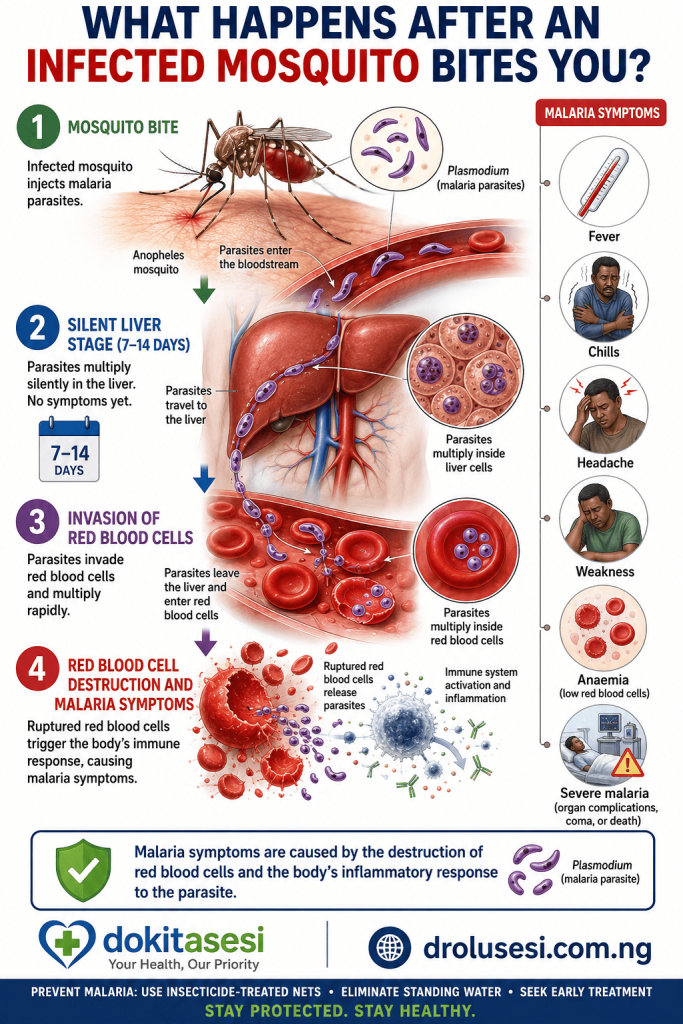
Here is the key points that most people do not know:
Semi-immunity to malaria is not permanent. It is earned repeatedly, and it fades.
You are not born with it. You build it up over years of repeated exposures. Children in Nigeria are especially vulnerable because they have not yet built it. That is why malaria kills more children under five than adults in Nigeria. As Nigerians grow older and continue to be exposed, they develop partial protection – not immunity that prevents infection, but immunity that controls how severe the illness becomes.
Why Some Nigerians Get Malaria Every Month
If you are someone who gets malaria frequently (once a month, or even more) it is almost never because you are “weak” or have a “bad blood type.” Here are the most common real reasons:
1. Your living environment has high mosquito density.
Areas with poor drainage, stagnant water, open gutters, or proximity to bushland have significantly more mosquitoes. More bites mean more exposures.
2. You may have underlying conditions that affect your immune response.
Conditions like sickle cell disease, HIV, diabetes, or chronic malnutrition can make it harder for your body to control the parasite load. If you are getting malaria very frequently, this is worth discussing with a doctor.
3. You are not sleeping under a treated net.
Insecticide-treated mosquito nets (ITNs) remain one of the most effective malaria prevention tools available. Many Nigerians own them but do not use them consistently.
4. Incomplete treatment of previous episodes.
This is very common in Nigeria. Many people start malaria medication, feel better after two days, and stop. The parasite is not fully cleared. It resurfaces. This cycle can repeat for months. Incomplete treatment also drives drug resistance.
5. Some people are genuinely more bitten.
Research shows that mosquitoes are attracted to certain body odors, heat signatures, and even blood type (Type A, B, and AB blood appears to be more prone to malaria infection). If everyone in your household gets malaria once a year but you get it four times, this could partly explain it.
Why Some Nigerians Rarely Get Malaria
This is the other side of the same coin.
People who rarely get malaria in Nigeria typically have:
- High continuous exposure in childhood and adulthood, which has built up strong semi-immunity
- Consistent prevention habits – regular use of nets, insect repellents, and keeping their environment clean
- Stable immune systems – no underlying conditions that weaken immune responses
- Lower mosquito exposure – perhaps living in well-screened, air-conditioned environments with reduced outdoor exposure at night.
It is also important to say this clearly: some people who say they “never get malaria” may actually be having mild, undiagnosed episodes. Low-grade fever, body aches, and tiredness that they chalk up to “stress” or “work” could actually be mild malaria their immune systems are controlling well. This is not rare.
The Diaspora Problem: Why Malaria Nearly Kills Nigerians Coming Home
This is perhaps the most underappreciated public health story in Nigerian family life.
A Nigerian who grew up in Lagos, moved to London at 25, and returns at 40 for their mother’s burial is not the same person immunologically as the one who left. Their semi-immunity, the hard-won biological protection built up over decades of exposure, has been fading every single year they were abroad.
After five years away, it is significantly weakened. After ten years, it may be almost gone. After twenty years, they are essentially an immunological first-timer walking into one of the highest malaria transmission zones in the world.
This is why what happens is so predictable, and yet so often surprises families:
- The returnee arrives. They are celebrating, eating, catching up.
- Three to seven days later, they develop fever, chills, severe headache, and body pain.
- The family says, “It is just malaria, take Coartem.”
- But this is not the malaria of someone with semi-immunity. The parasite multiplies rapidly in a body that does not know how to slow it down.
- Within 24 to 48 hours, it can progress to severe or complicated malaria, affecting the brain (cerebral malaria), the kidneys, or causing dangerous drops in blood sugar and dangerous levels of anaemia.
- By the time they reach a hospital, they may need intensive care.
This happens every year in Nigeria. It is preventable, but only if the family and the returnee take it seriously from the moment they land.
What Returnees Must Do
- See a travel medicine doctor or GP before you travel — ideally 4–6 weeks before departure. Discuss malaria chemoprophylaxis (preventive medication). Options include Atovaquone-proguanil (Malarone), Doxycycline, or Mefloquine. Each has pros and cons; your doctor will advise.
- Do not skip prophylaxis because “you are Nigerian.” Being Nigerian does not protect you if your immunity has faded.
- Use insect repellent religiously – apply to all exposed skin every evening. DEET-based repellents (at least 30%) are most effective. Picaridin is a good alternative.
- Sleep under a treated net, every night, even if the family home has AC.
- If you develop ANY fever within the first two weeks of arrival, treat it as malaria until proven otherwise. Do not wait. Do not assume it is jet lag or “the change in weather.” Go and get tested (a Rapid Diagnostic Test (RDT) or blood film) immediately.
- Tell whoever is hosting you about this risk. Your family loves you but may not understand why your malaria is different from their malaria.
Warning Signs That Mean You Must Go to Hospital NOW – Not Tomorrow
Whether you live in Nigeria or are visiting, these symptoms mean malaria has moved beyond “simple” malaria into dangerous territory:
- Confusion, difficulty thinking clearly, or unusual behaviour. This can indicate cerebral malaria
- Convulsions or seizures
- Inability to stand or walk
- Passing very little or no urine
- Yellowing of the eyes (jaundice)
- Vomiting everything – unable to keep any fluid or medication down
- Severe difficulty breathing
- Loss of consciousness, even briefly
- Fever in a child under five, a pregnant woman, or someone with HIV or sickle cell
Do not manage these at home. Do not send someone to the pharmacy. Go directly to a hospital with inpatient capacity. These situations can deteriorate in hours.
What You Can Do at Home Before You Reach a Doctor
This is where most Nigerian families need practical, honest guidance – not fear.
The reality is that in Nigeria, there is often a gap between when malaria symptoms start and when someone actually sees a doctor. Traffic, cost, distance, waiting times… all of these delay care. What you do in that window matters.
Here is what is safe and appropriate to do at home while arranging to see a doctor:
1. Get tested first if at all possible.
Pharmacies and patent medicine stores across Nigeria stock Rapid Diagnostic Tests (RDTs) for malaria. They are cheap, fast, and reliable. A positive result tells you it is malaria. A negative result tells you to think about other causes of the fever. Do not just assume.
2. Bring the fever down.
Paracetamol (acetaminophen) is safe for adults and children when given at the correct dose. Do not give Aspirin to children. Do not give adult doses to children. Tepid sponging (wiping the body with a cloth dipped in room-temperature water) helps bring fever down in children.
3. Keep hydrated.
Malaria causes sweating, which causes fluid loss. Drink clean water, oral rehydration solution (ORS), or coconut water consistently. Avoid alcohol entirely.
4. Do not start treatment unless you have confirmed malaria or a doctor has directed you to.
Starting the wrong medication wastes precious time and can mask symptoms that help a doctor diagnose what is really happening.
5. If you have confirmed malaria and a doctor or pharmacist has recommended an Artemisinin-based Combination Therapy (ACT), such as Coartem (Artemether-Lumefantrine), complete the full course, even when you feel better.
Stopping early is one of the biggest contributors to repeated malaria and drug resistance in Nigeria.
6. Monitor closely.
Check the person’s temperature every few hours. Watch for any of the danger signs listed above. If anything worsens, stop home management and go to a hospital.
A Word About Self-Medication Culture in Nigeria
This needs to be said plainly.
Nigeria has a deep culture of self-medication for malaria, buying drugs from patent medicine stores, taking whatever is left from a previous episode, or following advice from well-meaning neighbours. This culture exists because of genuine barriers: cost of healthcare, distance, distrust of hospitals, and the fact that simple malaria often does respond to treatment.
But this culture also kills people …slowly, through drug resistance, and quickly, when what looks like simple malaria is actually something else (typhoid, meningitis, sepsis) or when complicated malaria is underestimated until it is too late.
The goal is not to make every Nigerian run to a hospital for a headache. The goal is informed decision-making – knowing when home management is reasonable, knowing what to watch for, and knowing when the situation has changed and professional care is urgently needed.
Want a Step-by-Step Guide You Can Keep at Home?
Everything discussed in this article – and much more – is covered in detail in the free downloadable guide:
📥 MALARIA IN NIGERIA — What to Do at Home Before You Reach a Doctor
A Practical Guide for Nigerian Families
By Dr. Lukman Olusesi (MBChB, MPH)
This guide covers:
- How to recognise malaria vs. other common fevers
- A step-by-step home response plan for adults and children
- Drug dosing reference for common malaria medications
- When to treat at home vs. when to go to hospital immediately
- A special section for Nigerians in the diaspora visiting home
- What to tell your family before you travel
Download it free below. No complicated forms, just your name and email, and the guide goes straight to your device with a click
Summary: What You Should Remember
- Semi-immunity to malaria is real, but it fades. Nigerians abroad lose it faster than they realise.
- Frequent malaria in the same person deserves investigation, not just repeated treatment.
- Some people who “never” get malaria may actually be having mild, self-controlled episodes.
- Diaspora returnees must take malaria prevention seriously from the moment they book their ticket.
- Know the danger signs of severe malaria. They are not subtle. Act on them fast.
- Home management has a place — but only within clear limits, and only when you know what you are doing.
Dr. Lukman Olusesi is a Public Health Specialist with over 27 years of experience, a Commonwealth Professional Fellow, and the founder of Dokita Sesi – a health education and wellness brand dedicated to making medical knowledge accessible to Nigerian families. Visit drolusesi.com.ng for more.
Waoooo!
👏 kudos to you sir.
What an a,b,c analysis of the causes, symptoms to look for and the immediate first aids that can be applied if need be in the common sickness in arround our environs in Nigeria, called malaria fever.
Very educative piece. Well done, Dr. Sesi.
My feelings here in Nigeria is that we are surrounded by FAKE drugs. Hence, we are always faced with persistent malaria cases.
Thanks